![]() |
|
|
|||||
|
Reviews
|
|||||
|
|
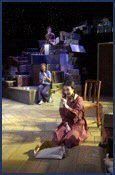
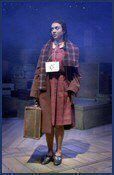
KindertransportBy Diane Samuels Between 1938 and 1939, ten thousand mainly Jewish children were given away by their parents and transported to Britain to escape from Nazi-controlled Germany, Czechoslovakia, Poland and Austria. Many of the parents of these children perished in the hands of the Nazis. The operation was known as "Kindertransport". Diane Samuels's play looks at one of these children and how the experience affects her in adulthood, and also how her own daughter is affected by these events. Eva (Claire Redcliffe as a child; Janice McKenzie as an adult) is put on a train by her mother Helga (Anna Northam) in Germany and arrives in England to be fostered by Lil (Ann Rye). When she is sixteen, Eva changes her name to Evelyn, becomes naturalised as a British citizen and blocks out her German past completely, even from her daughter Faith (Christabel Fellowes); that is, until Faith finds a box of letters and photographs in the attic that seem to show that her mother is not the person she believed her to be. The whole play is set in an attic room, but Dawn Allsopp's superbly striking set takes a symbolic approach to portraying this location. The stage is dominated by a huge pile of trunks and suitcases - with the occasional teddy bear - forming a steep staircase to an upper platform. The wooden floor has a design in it resembling railway lines, which lead to the door, and even the footlights shine from inside a suitcase. Both the present-day action and the flashes back take place in the same space, sometimes at the same time, and this set, lit superbly by Thomas Weir, works very well for this. Alexander Delamere's original music is nicely atmospheric.
The play itself looks at identity and how the identity of the parent - or the concealment of a crucial component of that identity - can have an effect on the child. Considering the gravity of the subject matter, this play rarely gets very far below the surface of any of the issues it touches on. The wartime scenes work best because there is a definite story to them, whereas many of the present-day scenes are repetitions of the same argument between mother and daughter which never progresses. The split scenes and the Ratcatcher's constant presence help to keep the attention, but there is a bit of "style over substance" about the play. There are many scenes in this production that are performed with warmth, humour and emotion. However there are also a few times when the actors seem a little lost and the play lacks pace. There are a couple of notable exceptions: Alexander Delamere is always excellent as the constant sinister presence of the Ratcatcher who also plays a number of other characters, and Claire Redcliffe is superb as the young Eva, aging convincingly from nine to seventeen and becoming more English. Mark Babych's direction has done some far more interesting things with the character of the Ratcatcher than the published script of the play indicates, including a nice little touch at the end that creates a significant twist, although it is still not too clear exactly what this character symbolises. Overall this is an enjoyable production with the Octagon's usual high production values that tells an interesting story, but one that never seems to get to the heart of the characters or their situation and is surprisingly unemotional (Faith's frequent tears often seem forced) for such an emotive subject. "Kindertransport" runs until 22nd May, 2004
|
||||
|
|