South Shields, on the south bank of the mouth of the River Tyne, has what is probably the oldest established Arab population in England. It is also one of the most well integrated: during the last century there was a great deal of intermarriage and surnames such as Hassan and Abdulla are fairly commonplace, almost as commonplace as those from that other immigrant population, the Irish. As writer Peter Mortimer says in his programme note, South Shields is probably now the most racially harmonious town in England and I have to say that, having worked in the town for the last twenty years or so, I would agree entirely.
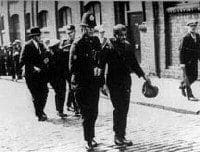
But on 2nd August, 1930, there was a riot in the Mill Dam area (where the Customs House now stands) which involved Yemeni sailors, the men of the Seamen's Minority Movement and the Communist Party, ranged against the shipping employers, the police and a section of the National Union of Seamen who, in a desire to protect "white" jobs, were prepared to support a system of giving jobs which discriminated against the Yemeni sailors.
It's a bit reminiscent, on a much smaller scale, of the Miners' Strike.
Mortimer's play is based on this riot, although he adds a love story between a Yemeni sailor, Yussuf (Leonard Estranero), and Thelma (Janine Leigh), the daughter of a Shields seaman who was injured when his ship was sunk during the First World War. The addition of this personal layer to the story prevents it from slipping, as it so easily could, into agit-prop. As Mortimer says, "playwrights often begin with issues but are then also pulled towards characters". Certainly here the addition of the personal, in terms of audience involvement with the characters, both contrasts with and underscores the political, and adds to the impact of the piece.
The play follows the usual pattern of such plays in that it consists of a number of short scenes in which the focus moves from character to character, but they are all linked together, not only thematically but also by the character of the News Vendor (Wayne Miller), who is also, variously, a waiter, a masseur and a range of others. This character also frequently reminds us of the theatricality of what we are watching by mentioning that they are on a stage and playing to an audience.
Geoff Ramm's excellent set (probably the best I have seen in a Customs House production) not only sets the scenes effectively but also enables the transitions between scenes to move rapidly.
The play could do with a little cutting in the second half and a few scenes need to be speeded up. Unfortunately theatres like the Customs House cannot afford the luxury of previews (it only runs until Friday 28th) when such problems can be sorted out without being remarked upon by carping critics!
I can't help feeling it was a mistake to stage the rabble-rousing Communist's speeches at the back of the stage: the distancing meant that the passion was lost. On the other hand, director Darren Palmer (who is, incidentally, himself of Yemeni descent and his grandfather actually took part in the riot) staged the riot itself as a movement sequence whose language was based upon Islamic prayer and was accompanied by the call to prayer of the muezzin, expressively and hauntingly performed by Neji Nejah. This was tremendously effective and certainly solved the problem of presenting a riot with so few people.
Riot is essentially an ensemble piece but a great deal depends upon the linking character, the News Vendor, for it is he who keeps it moving from scene to scene. The part could almost have been written for Wayne Miller whose comic sense kept the audience amused and interested during the transitions, as well as puncturing the pretensions of the wonderfully arrogant Scott Solway as the shipowner Charters. Of course, much, too, falls upon the shoulders of the lovers and both Estranero and Leigh (both newcomers to the Customs House) did that job well. Leigh, in particular, created a delightful character. Their interaction, too, with her father (played by the ever reliable Neil Armstrong) provided some of the play's highlights.
Peter Mortimer admits that, during the play's development period, he was tempted to "forget the play, let sleeping dogs lie". It's just as well he didn't or the Shields' audience would have been deprived of a powerful and enjoyable piece about a little known part of their history.
Finally, I feel it necessary to declare an interest here: not only is Wayne Miller a BTG reviewer but he is also a former student of mine. I can assure readers that I took soundings from other audience members before commenting upon his performance!